Thank You, LLA!

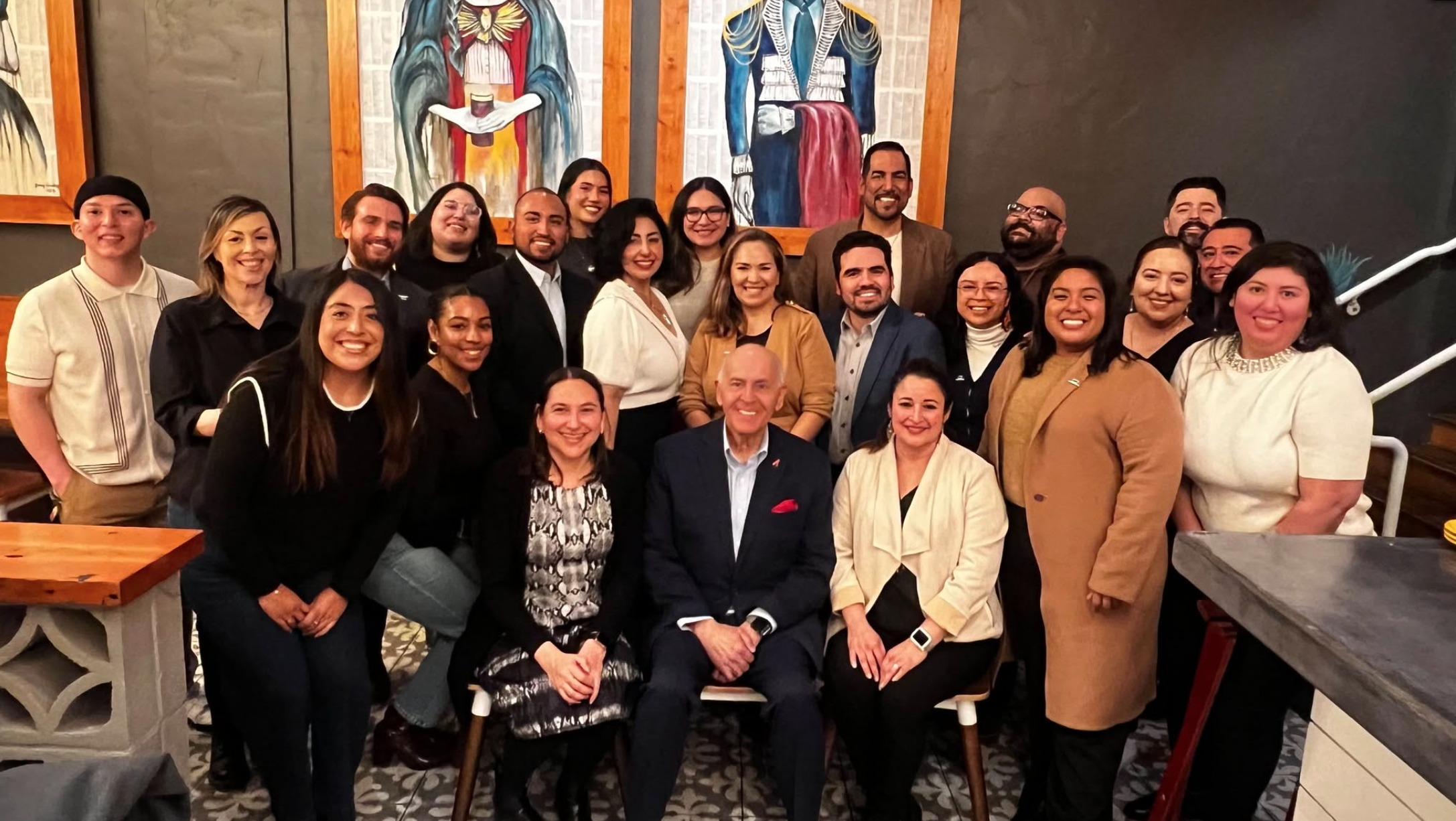
LLA Leadership Academy and Stanford Summer Leadership Institute, Cohort 15

The mission of the Latino Leadership Alliance (LLA) is to empower Silicon Valley Latino leaders to promote a common voice that addresses the interests of our community, and to identify, develop, and support future leadership. ~ Adopted by LLA Cofounders, 2005

***

During the summer of 2004, while hiking in the Sierras as a Class XVIII fellow with the American Leadership Forum of Silicon Valley (ALF-SV), I thought about creating a similar organization that could train emerging Latino and Latina community leaders to manage the complex world of civic leadership. I shared the idea with a couple of Latino and Latina elected officials. They convened a group of eight community leaders to brainstorm ideas to create such an organization. 

The group included San Jose City Councilwoman Nora Campos, San Jose Planning Commissioner Xavier Campos, San Jose City Councilwoman Cindy Chavez, Santa Clara/San Benito Counties Building Trades Council Executive Josue Garcia, East Side Union High School District Trustee George Shirakawa, MACSA Executive Director Olivia Soza Mendiola, and Mt. Pleasant Elementary School District Trustee Fred Tovar. As the eighth member of the group, I was a junior executive at Comcast and board chair for the Mexican Heritage Corporation.

Over the course of several months meeting in living rooms, we established a name for the  organization, adopted a mission statement and core values, and discussed the concept for a leadership academy. By early 2005, we established the Latino Leadership Alliance (LLA) “to empower Silicon Valley Latino leaders to promote a common voice that addresses the interests of our community, and to identify, develop, and support future leadership.” Guiding our work were seven core values:

  1. Cultural pride is the foundation of our success.
  2. Honor and integrity guide our every action.
  3. When united we are an effective force.
  4. Our community deserves to be respected and portrayed honestly and fairly.
  5. We are committed to leading and nurturing the community that nurtures us.
  6. Our united presence and influence are vital to the success of the community.
  7. We will never take money or support those who harm the Latino community.

I eagerly accepted the task of developing the leadership academy. The eight Cofounders agreed that the academy should focus on three overarching objectives: (1) servant leadership, (2) practical (as opposed to theoretical) application of leadership, and (3) challenges of serving the community as a Latino leader. As senior fellows with the ALF-SV, we were inspired to base the academy on that proven model. I also included elements of the Comcast Executive Leadership Forum, a program I benefitted from as a young and ambitious junior executive.

Both programs included three major components: (1) monthly seminars, (2) leadership retreat, and (3) alumni network. To ensure that the Cofounders’ shared commitment to preparing participants for civic leadership was covered, I developed the Four Pillars of Community Leadership model (Business, Nonprofit, Education, and Politics/Government) based on my career experience working in each pillar.

An early challenge was creating a leadership retreat from scratch. The ALF-SV retreat is a week-long camping trip in the high Sierras. Cofounders were in agreement that operating the academy should be affordable to participants. A wilderness retreat was financially out of the question. The Comcast ELF retreat was a week at the company headquarters in Philadelphia. Comcast senior executives and college professors served as presenters. That concept led to the idea of the LLA collaborating with a university. 

What happened next could be a scene from a feel-good movie or maybe a sitcom. Three of us, including fellow Cofounder George Shirakawa, drove north on U.S. 101 to meet with Professor Al Camarillo, the legendary Father of Chicano Studies . . . at the Stanford Faculty Club! We were excited about the opportunity just to be there, making jokes about three traviesos from east San Jose in the distinguished Stanford Faculty Club without supervision to meet the university’s most decorated professor. What could go wrong?

Professor Camarillo was down to earth and “one of us.” He praised our presentation and supported our proposal. Under his leadership, the LLA would collaborate with Stanford’s Center for the Comparative Studies of Race and Ethnicity. We had the final piece needed to build a solid leadership academy that would be culturally relevant to our experiences as civic leaders in a political environment that isn’t always accommodating or friendly to Latinos.

The Academy consists of twelve to fourteen participants from the business, education, nonprofit, and political/government sectors. The cohorts engage in eight monthly full-day seminars that include workshops, reading assignments, leadership exercises, and guest speakers. The monthly seminars are held at a variety of places in the community. During the summer, the cohort spends three days and two nights with university faculty at Stanford.

Participants learn about five major leadership concepts: (1) Servant Leadership, (2) Relationship Development & Management, (3) Living and Leading Holistically, (4) Civic Engagement, and (5) Leadership Communications. The LLA Stanford Summer Leadership Institute is developed and coordinated by Stanford faculty. The capstone to the program is the Cohort Community Project developed and executed entirely by the cohort participants. In early 2010, the inaugural cohort of the LLA Leadership Academy and Stanford Summer Leadership Institute served as the beta test. Fifteen cohorts have completed the program through September 2025.

The LLA Alumni Network includes 184 members who have made significant contributions to community life in Silicon Valley. Eight alumni served or currently serve on city councils in three different cities. Nine alumni served or currently serve as trustees on five different schools boards. There are scores of LLA alumni serving as local government commissioners and nonprofit board members.

LLA-trained business and nonprofit executives, and public school administrators and superintendents serve the community with cultural relevance and skill. In 2022, Governor Gavin Newsom appointed a LLA alumnus to serve as a judge in the Santa Clara County Superior Court. By all measures, the LLA Leadership Academy and Stanford Summer Leadership Institute has been an overwhelming success.

My professional career included four distinct periods. While each of those experiences holds a special place in my journey, the creation and development of LLA combined all four into one passion – sharing my experiences to support talented civic-minded and career-focused Latinos and Latinas on their leadership journeys. For 21 years, LLA has been my life’s work.

On June 7, 2025, I sent a letter to the LLA Board of Directors to announce that Cohort 15 would be my last. It was a difficult decision with a practical purpose. It’s important for leaders to have the wisdom to hand over the keys to the next generation so the organization can grow and thrive. The time was right for LLA to forge a path into the future without my support. Although my door is always open to LLA alumni, my work here is done.

As I say goodbye to LLA, my heart is filled with gratitude and accomplishment. There are too many individuals to thank, so I’ll do it in groups. First and foremost, I have deep respect and appreciation for my fellow Cofounders for having the vision, courage, and determination to bring an overdue idea to life. Thank you for your confidence in me to develop the Academy in collaboration with your guidance. We had our share of challenges and trials in building the LLA. Our commitment to be united, stay true to the mission and core values, and leave our titles and personal political agendas at the door ensured that we weathered any and all storms.

Second, thank you to the twelve cohorts and 145 participants I had the privilege to work with while facilitating the Academy. You all are valued leaders in the community. Third, thank you to the many guest speakers and panelists who took precious time from their busy schedules to share their wisdom with our cohorts. I’m also grateful for the private companies, school districts, nonprofit organizations, city council members, and county supervisors for generously providing space or monthly seminars over the years.

Last, but certainly not least, two individuals warrant special acknowledgement. Thank you, Dr. Al Camarillo for taking a chance on a LLA. The Stanford collaboration has been the hallmark of the Academy. Thank you, Dr. Tomas Jimenez for carrying the torch and for your continued commitment to LLA. I appreciate and value the partnerships and our friendship.

It’s been an honor of a lifetime to work with all the people it takes to make the LLA Leadership Academy and Stanford Summer Leadership Institute the premier Latino civic leadership development organization in the Bay Area. All I can do is humbly offer my deepest appreciation and respect for you all.

As time goes on, LLA is sure to expand and explore different leadership development models. My hope is that the current board leadership and future LLA leaders find wisdom in the core values envisioned by the Founders. If they conduct the organization’s business with those values in mind, LLA’s future is without limits!

Once again, thank you LLA! It’s been an amazing journey.

Resilience and Perseverance

To stand here is to feel free at last from the stinging rejection that so many of us have felt for being Mexican-American. To be able to speak our language and to experience our cultura in its many forms is to acclaim our right to be. 

~Honorable Blanca Alvarado, Santa Clara County Supervisor, September 9, 1999

* * *

It’s been some time since I’ve written on this blog, 141 days to be precise. Here’s the scoop. I’m working on my second book. It’s not a sequel to Summer in the Waiting Room and it’s not about my personal life. I’m doing historical research and writing about the Mexican American experience in San Jose, California. The story doesn’t paint a rosy picture. 

Society’s current view that Mexicans are hard working people is a recent phenomenon. Less than a generation ago, the majority of the population used the adjectives “dirty” and “lazy” to describe Mexicans. My family’s experience and research on my book, however, indicate that the words “resilience” and “perseverance” more accurately portray Mexicans and Mexican Americans. 

The racist policies of the current presidential administration are nothing new. When California became part of the United States in 1850, the largest landowner in San Jose was a Mexican American rancher named Antonio Chaboya. By 1863, he lost 90% of his land as a result of the California Land Act of 1851. It’s a fascinating story that I’ll describe in my upcoming book. Chaboya’s fate was shared by many ranchers throughout Santa Clara Valley during the same era. The story of Mexican Americans in San Jose is littered with similar tales of exploitation in its 175 year history as an American city.

Despite those kinds of setbacks, the Mexican American community in San Jose has survived and thrived. From the 1950s to the mid-1970s, downtown San Jose was the epicenter of the Bay Area’s largest Mexican American business district. The City ultimately demolished it to redevelop the city center. With resilience and perseverance, Mexican Americans in San Jose recovered from the destruction of their thriving downtown business district to secure places of influence in the community today. 

I’ll keep readers posted on the book’s progress. There’ll be more information in the months to come.

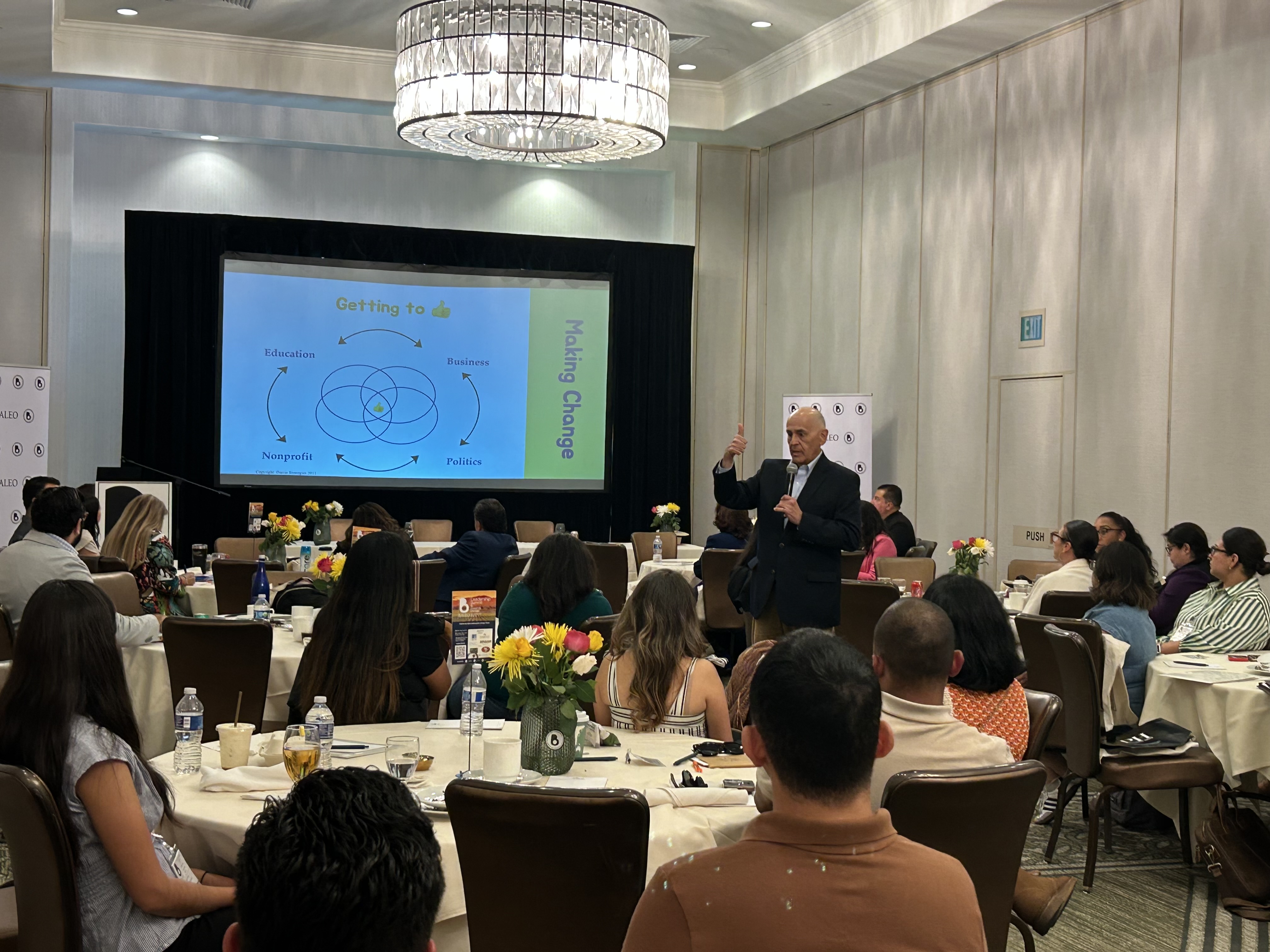
I stepped away from my book project this weekend to work with Cohort 15 of the Latino Leadership Alliance (LLA) Leadership Academy. The Academy is an eight-month leadership program that engages, mentors, and mobilizes the next generation of Latino and Latina civic leaders. Last weekend’s Academy workshops focused on politics and local government. The sessions were held in conjunction with the Bay Area Latino Elected and Appointed Officials (BALEO) Leadership Summit in Napa, California. I was also a presenter at the Summit.

The attempt to take mental leave of my book project was in vain. The weekend in Napa was a powerful and uplifting demonstration of Latino resilience and perseverance. All around me I was reminded of the struggles and triumphs found in my research. 

Friday morning began with a LLA Leadership Academy seminar on how local government works and the importance of Latinos engaging in the political process. With the BALEO summit in session at the same time, the LLA Academy cohort had the benefit of engaging with a panel of Latino and Latina elected officials from Mountain View, Morgan Hill, San Jose, and Santa Clara. The politicians shared experiences about the challenges and opportunities of serving in political office.

That afternoon, I presented a community leadership model to a room full of elected county supervisors, city council members, and school board trustees who represent communities from Napa to the Central Valley. The best part of the afternoon was the Q&A and exchange of ideas. Many in the room were the first Latino or Latina ever elected in their jurisdictions. With resilience and perseverance, they each have had to overcome inherent biases to bring fresh perspectives to solving problems in their respective communities. Their work inspires me.

Saturday was a day of celebration. As a conference speaker, I was invited to join BALEO and corporate leaders in a suite at the Bottle Rock La Onda Festival in Napa. The festival attracts major musical acts from Mexico and Latin America on two giant stages in a large park. More than 40,000 people attended this amazing event. After spending time networking and thanking our hosts, Sandra and I ventured out into the festival to listen to music.

We meandered our way through the crowd to get a closer look at Pepe Aguilar before his set began. Pepe is the scion of the Aguilar musical family. His father Antonio was fondly known as El Charro de México (Mexico’s Cowboy). I grew up listening to Antonio Aguilar. Pepe is just as famous as his legendary father, and, in my humble opinion, a better singer. Pepe’s daughter Angela, a rising star in her own right, performed at La Onda the next day. By the time Angela reaches her father’s age in about 30 years, the Aguilar Family will be on top of the Mexican music world for over 100 years! But, I digress . . . 

There was exciting anticipation in the air as Pepe Aguilar’s mariachi stepped onto the stage and the crowd roared when the musicians started playing Son de La Negra, the traditional mariachi “walk up song.” The mariachi seamlessly transitioned into El Cihualteco (The Man from Cihuatlán), a classic son jalisciense from the Mexican state of Jalisco. Pepe’s magical voice mesmerized the throng as he sang about a man from a small Mexican village. Although the sweltering late afternoon sun was hot, I felt chills, proud of my Mexican heritage, as goosebumps popped up on my arms.

The mariachi’s first notes of Se Me Olvidó Otra Vez, written by the late Juan Gabriel, perhaps Mexico’s most famous and prolific singer/songwriter, sent thousands of people into a frenzy. It seemed like everyone in the crowd, young and old, sang along with Pepe, feeling the pain and suffering of every word from the song about unrequited love. More chills. More pride. More goosebumps.

In the faces of the masses singing each lyric, I could see the pain and suffering of the ranchers who lost their land to unscrupulous lawyers and squatters during the 1800s. I could see the sadness of the families that lost their homes in downtown San Jose to make room for the city’s new gleaming buildings. As people were singing, I couldn’t help but believe that all of us in that crowd were in one way or another sons and daughters of those exploited Mexican ranchers and downtown families. 

As it turned out, one of the most popular Mexican music groups was denied entry into the United States and canceled its appearance at La Onda. From the stage, as a first generation American born in San Antonio, Texas, with dual Mexican-American citizenship, Pepe Aguilar fearlessly talked about the current presidential administration’s exploitation of our people to the delight of the audience. Hope was the order of the day.

As an encore, Pepe Aguilar sang his rendition of Un Puño de Tierra, a song his father made famous. It’s an upbeat ranchera song about living life to the fullest. 

On the day that I die,

I won’t take anything with me.

You must live life to the fullest

for it ends too soon.

Of all that happens in this world,

All that’s left are the memories.

When I die, all I’ll take

is a fistful of dirt.

The pain and suffering in the faces of the crowd gave way to happiness as people danced away with joyful abandon. Pepe had it right. Whether life gives you rocks or all the riches in the world, you can’t take it with you. That’s the spirit of resilience and perseverance in the face of exploitation and persecution. 

RIFF Magazine, a major online music publication, wrote in its post-festival analysis about  La Onda, “It wasn’t just about the music, but about persistence and pride.” Damn right! The Mexican American and Latino community in the United States will weather the latest storm. Organizations like BALEO and LLA will continue to organize and grow an influential footprint. We’ll be stronger than ever.

As comedian George Lopez likes to say, “we ain’t going nowheres!”

Today is Gonna Be a Good Day

We know that we are children of God, and that the whole world is under the control of the evil one. ~1 John 5:19

We also glory in our sufferings, because we know that suffering produces perseverance; perseverance, character; and character, hope. ~Romans 5:3

So faith, hope, love remain, these three; but the greatest of these is love. ~1 Corinthians 13:13

* * *

Heart attack. Cardiac arrest. Lung failure. Ventilator. Induced coma. Paralysis. Physical therapy. Occupational therapy. Speech therapy. Heart failure. Heart pump. Heart transplant. Organ rejection. Whew! That was a long ride . . .

January 8, 2025 was a good day. A dear friend and role model called my name. I stood behind the wide podium. Over 400 Rotarians listened and watched slides of my ordeal pass by on a big screen. Heart disease is the world’s unmatched killer, I said. Not cancer. Not accidents. We can conquer it. What are we to do? Hope is the answer. Yup, I said that. Hope is the answer. 

Not whimsical desires we all crave when the chips are down. Not that hope. Rejoicing in suffering. Persevering. Building character. That’s the hope I talked about. The audience stood. Applauded. Gratitude filled my soul. “What’s next?” A shout came from the back of the room. I’ll walk to the elevator. Then take a drive to see a sick friend. The answer came from the podium. 

An hour later, I was on the other side of the hill. My dear friend had cancer. Cancer is #2! He was a mentor. A champion. A good man. He made the pressures of the ladder bearable. Even fun. He was dying. The doctor checked his vital signs. His family stood and sat in vigil. Morphine kept him comfortable. He was serene. He didn’t recognize me. My voice raised his eyebrows. Maybe he recognized me. Maybe not. I shared a funny story from the executive suite. He let out a faint grunt. Maybe he laughed. Maybe not. I held his hand. I thanked him. I’ll see him again. Not sure when. Not my call. 

Dinner with Sandra and the girls was nice. January 8, 2025 was a good day. 

January 11, 2025 was a good day. I climbed the ladder. Christmas lights had been up for a month. Climbing ladders gives me pause. Many years ago, a dear family friend fell from his roof after climbing a ladder. He passed from this life to a better one. It was sudden. It was shocking. Accidents are #3! I climb ladders anyway. It’s God’s call. When I climb, I’m extra careful. Not too high. On solid ground. Hooks and lights come down. One at a time. Don’t lean Eddie! I’m not 30 anymore. Break time. Back up the ladder I go.

Social media tells us that life is wonderful. Exciting! Amazing! John tells us that “the whole world is under the power of the Evil One.” Which one is it? Tinseltown is an inferno. God’s home on earth is submerged in ash and rubble. Wars of conquest are in fashion again? The Orange One is soon back in the saddle. His supporters say that God is by his side. Trump #2? Ha! Step down a rung Honest Abe. Lincoln is in second place. Their god isn’t the real God. Their Jesus doesn’t like the poor. The lame. The other.

Angelenos will ultimately rejoice in their suffering. Palestinians, Israelis, and Ukrainians will persevere. Americans will build character in the circus. Faith will lead the way. God is in charge. There’s always hope. And the greatest of these is love. Not brotherly love. Not romantic love. Not friendly love. God’s love is the greatest. Serving others is the greatest. “Love one another. As I have loved you, so you also should love one another.” That’s what the real God says. No strings attached. You don’t have to be rich, white, and “Christian.”

Dinner with Sandra and the girls was nice. January 11, 2025 was a good day.

Nathan only had but one life to give for his country. I’ve had five! November 6, 1963. June 7, 2010. June 18, 2010. November 6, 2018. April 16, 2020. Four more to go. I’ll take one day at a time. Faith. Hope. Love. That’s the way. Life is exciting! Life is amazing! Not the social media kind. The hard kind. We are children of God. The kind to rejoice in suffering. The kind to persevere. The kind to build character. That kind. There’s always hope.

Today is gonna be a good day!

Fighting the Good Fight

There is a time for everything, and a season for every activity under the heavens. ~Ecclesiastes 3:1

* * *

Si Dios quiere (God willing). Con el favor de Dios (With God’s support). I think those were my mom’s two favorite phrases. She used them all the time. 

Me: “Mom, I don’t know how to say this. I was academically disqualified from San Jose State. I flunked out.”

Mom: “Don’t worry, mijo. You’ll figure things out con el favor de Dios. I know that you’ll get back in school and graduate, Si Dios quiere.” 

That’s not exactly how that conversation went, but you get the picture. Yeah, Mom was fluent in Spanglish. Regardless of what language she spoke, God was always in the conversation. She truly believed that everything happened for a reason. And, of course, God was making it all happen. The funny thing is that’s how it played out. I’m grateful that she was still alive to see me get married, start a family, graduate from college, and start a career.

Her worldview was, “Why worry about something you can’t control?” She was an easygoing woman of faith. Unfortunately, I didn’t get that quality from her. I always struggled when life’s storms shook things up. The darkest time in my life was immediately after the heart transplant in 2020. I know. It doesn’t make sense. I just got another shot at life. But, I’m not alone. According to Stanford University, “up to 63% of heart recipients develop anxiety and/or depression during the first post-transplant year.” 

My mind convinced me that I was useless and worthless. I could no longer provide for my family like I used to. My attempts to return to the community work I loved so much fell on deaf ears. It seemed like there wasn’t a place for me anymore. While Sandra and the girls steadfastly cheered me on and showered me with love and support, my distorted reasoning continued to remind me that I had nothing to offer them either.

My growing faith helped me understand that everything was in God’s hands and therapy restored my confidence that I still had value to my family and community. I had come to accept that a lucrative career was no longer viable and opportunities to share my community leadership skills were limited. While giving up isn’t in my DNA, I slowly began to realize that chasing windmills was fruitless and potentially harmful, as my health crisis so clearly demonstrated.

By mid-June 2023, things were looking up. I was working with the Latino Leadership Alliance (LLA) Academy training emerging civic leaders and working with high school students at The Foundation for Hispanic Education (TFHE) again. One day that summer, I was walking out of the dentist’s office when the caller ID on my cell phone displayed a number from a strange area code. It’s not my practice to answer calls from unknown sources. For some reason, I answered it.

“Hi Eddie, my name is Scott Leezer from the Honor the Gift Coalition.” Scott went on to describe his organization and explain how Medicare decided to no longer cover a critical blood test for transplant recipients. He heard that I benefited from the innovative test and asked if I was interested in going to Washington, D.C. to share my story with lawmakers. I was skeptical and asked a bunch of questions. A week later, I was on Capitol Hill. 

For three years, I worried about what would become of my post-transplant life. Sandra, who has the same strong faith as Mom, encouraged me to just go with it. God will reveal His plan for me in his time, she assured me. Within the span of a few months, LLA, TFHE, and a stranger named Scott Leezer came calling. God knew I was ready physically and mentally to re-engage with the world. There is a time for everything, and a season for every activity under the heavens.

I consciously approached these activities not with the same vigor, ambition, and urgency that I conducted my life before a massive heart attack changed everything. I proceeded with patience, gratitude, compassion, and humility. The day on Capitol Hill was special (see Honoring My Gift on ESEReport.com) and led to a second trip to Washington, D.C. in August 2023 with a larger group of fellow transplant warriors. We were fighting the good fight for a good cause.

The Honor the Gift Coalition is an alliance of 17 transplant support organizations. The campaign to restore Medicare coverage for the post-transplant blood test  caught the attention of influential leaders. Sen. Alex Padilla (D-CA), Rep. Anna Eshoo (D-CA), and Rep. Michael Burgess (R-TX) led a bipartisan group of lawmakers asking Medicare to justify its decision. Civil rights icon Rev. Al Sharpton, former Speaker of the House Newt Gingrich (R-GA), and legendary soul singer Al B. Sure! and his Health Equity in Transplantation Coalition joined the fight!

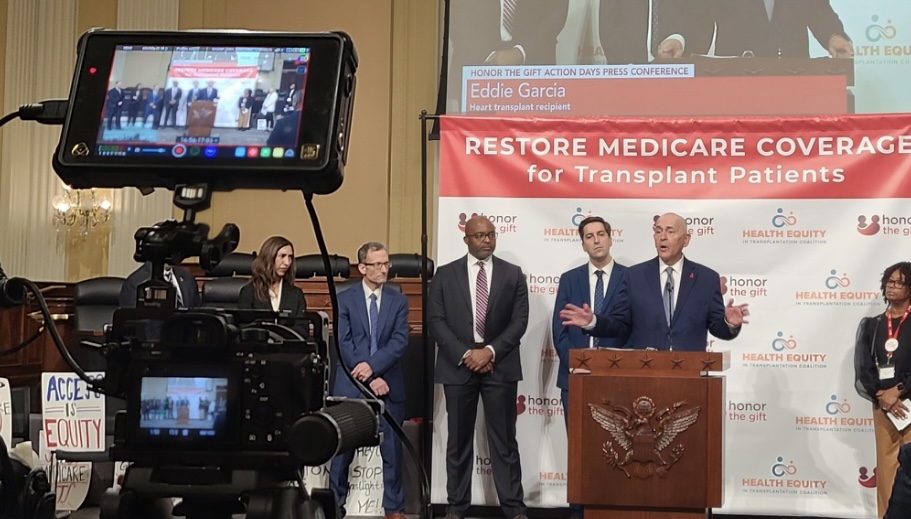
With the support of CURA Strategies, a Washinngton, D.C.-based public relations firm, the coalition led a group of over 140 transplant patients and caregivers on a march and rally in front of the Hubert H. Humphrey Building (home to the Human and Health Services Department) demanding that Medicare reverse its decision. I had the honor of representing transplant patients at a press conference held in the Canon House Building later that day.

In December 2023, Scott Leezer called again with another intriguing request. “Eddie, I bet I’m going to ask you a question that you probably never thought anyone would ever ask,” he started. Former Speaker Gingrich was looking for a patient voice to be a guest on his Newt’s World podcast. Would I be interested in sharing my story? Gingrich’s brand of right-wing Republican politics represents everything I believe is wrong with our country. After a long pause, I responded, “of course, for the cause.” Gingrich was gracious and a champion on the issue.

I went into the holidays feeling grateful for Sandra and the girls, friends and family, and for having the opportunity to do something meaningful in my life. The holidays were nice and uneventful. I didn’t give much thought to the whirlwind year of community service. I was invited back to work with LLA and TFHE in spring 2024. It seemed like my volunteer work in Washington, D.C. was done. Change in Washington is so slow. The professionals would carry the torch going forward.

Nine months later, I was back in Washington. This time it was to celebrate the Honor the Gift Coalition and the Health Equity in Transplantation Coalition’s successful campaign to overturn Medicare’s decision to stop covering the blood test. In an almost unprecedented move, Medicare changed its position on coverage. I stood alongside Rev. Al Sharpton, Al B. Sure!, and others to share my story yet once again.

The next morning, I took a walk around the White House before heading to the airport to catch a flight home. I reflected on so much. First and foremost, I made a commitment to follow Sandra and Mom’s advice to trust God’s plan and just go with it. Playing a small part in the Honor the Gift campaign was an experience of a lifetime. I met people from all over the country and opened my heart to make new friends. 

Walking by statues and  marveling at the majesty of the White House reminded me that we still live in a thriving democracy despite the political circus that threatens our existence. People do matter. We started this campaign with four people walking the marble halls of the Capitol trying to raise awareness about a wrong. The media and influential people joined the movement. The support grew exponentially until Medicare had no choice but to take notice. 

Even though a wrong was righted this time, these kinds of things are never truly over, especially during these politically uncertain times. The Washington, D.C. professionals will keep an eye on it. Thousands of new transplant recipients will benefit from the work. If ever called upon again to help, I’ll trust that God initiated the call. If my work on this issue is done, I’ll continue to live with faith, hope, and love, and stay in touch with friends new and old. 

Room 2301

Room 2301, Kaiser Santa Clara ICU, July 30,2024

Agape love is selfless love . . . the love God wants us to have isn’t just an emotion but a conscious act of the will—a deliberate decision on our part to put others ahead of ourselves. This is the kind of love God has for us. ~Billy Graham, 20th Century American Evangelist

* * *

After 5,083 days, I returned to the scene of the crime. The scene was Room 2301 in the ICU at Kaiser Santa Clara Medical Center. The crime was being “intubated, sedated, and paralyzed.” That’s my medical record’s way of saying that I was on life-support machines, in a medically induced coma, on heavy muscle relaxation medication. The suspect was Acute Respiratory Distress Syndrome (ARDS), a rare disorder that shuts down the lungs.

The reason for my return was visiting a family member who was recovering from heart surgery. Just as she had done 14 years earlier, I sat in the waiting room from Summer in the Waiting Room: Faith • Hope • Love. I experienced the anxiety, uncertainty, and hope my family endured that fateful summer. The room was full of the same faith, love, laughs, concern, and ultimately relief when the surgeon reported a successful operation.

Much has happened in those 5,083 days. I returned to work as chief of staff for an elected official only to be unceremoniously walked out of my office when the politician resigned. I wallowed in uncertainty as a 47 year old man with severe congestive heart failure and a career in tatters. I started a consulting business with a couple of clients, but it didn’t take away the sting of failure or cure my deteriorating heart. As my badly damaged heart weakened, so did my mental health. 

I embarked on a faith and mental health journey that continues to this day. I’ve learned that faith is accepting God’s will, hope is an action word, and the meaning of true love is agape, the ancient Greek word for God’s love of putting others ahead of ourselves. The Buddhist principle of mindfulness, defined by mindfulness guru Jon Kabat Zinn as “paying attention, on purpose, in the present moment, without judgment,” is now part of my consciousness. I’m learning how to focus on the here and now.

I wasn’t sure what to expect from returning to the ICU where my life hung in the balance for more than a month. According to the National Library of Medicine, ARDS survivors experience “a high prevalence of substantial symptoms for depression, anxiety and PTSD.” I’ve experienced all three during the past 14 years. I wondered if returning to the scene of the crime would trigger one or all three of the psychological conditions. Regardless of those concerns, agape inspired me to be there to support the family.

Walking into the cardiovascular ICU waiting room was surreal. I surveyed the space and imagined what it was like 14 years earlier. Family members brought my imagination to life by sharing stories of that fateful summer. Water and sodas were stacked in that corner. Food brought in by visitors sat on this small table. Tío Pancho and Nino Miguel chomped down pupusas on those chairs over there. The summer of 2010 came to life as we anxiously waited for the surgeon.

Six hours after we arrived, our loved one was rolled into the ICU for recovery and the surgeon reported a successful operation to the waiting room. We were allowed to see her in pairs. When the heavy double doors to the ICU slowly opened, it was like walking into a time capsule. The names and faces were different, but the scene was the same. Doctors, nurses, and other healthcare professionals were busily caring for patients and keeping a close eye on the monitors that measured the progress of each patient.

As Sandra and I weaved our way through the ICU trying not to get in the way of the healthcare teams, we walked by Room 2301. The room was empty. I tentatively peered into the unoccupied space as a range of emotions washed over me. I pictured myself on the bed with a breathing tube in my mouth, a ventilator by the bedside, and a forest of IV stands holding bags of fluids and medications.

I thought about the suffering combined with hope that Sandra, the girls, and family and friends endured day in and day out while in the waiting room on the other side of the wall that summer 14 years ago. Surprisingly, I had no negative reactions. My stomach didn’t do a flip as it does when anxiety sets in. Neither sadness nor depression creeped into my psyche. For a few more seconds, I stood in front of an empty Room 2301 in awe of the power of faith, hope, and love.  A nurse leader graciously took a pic of me standing by the door.

The next few days turned out to be a reunion of sorts. In the hallways of the ICU and later the cardiac unit, I ran into the occupational therapist who taught me how to use my hands again in 2010. Nurses and technicians who cared for me after my LVAD (mechanical heart pump) implantation surgery in 2018 heard I was in the unit and stopped by to say hello. Their smiles and genuine hugs of joy to see a former LVAD patient thrive with a heart transplant warmed my soul.

At the end of the week, I felt a sense of profound gratitude. Kaiser Santa Clara’s top notch cardiology team performed another successful heart operation, its patient was comfortably recovering at home, and I was able to see my own journey from another perspective. The uncertainty of heart surgery and being bombarded with data, numbers, and medical terms difficult to understand is stressful. I saw my fellow heart surgery warrior and her nuclear family endure the week with grace, courage, and their trademark humor.

Perhaps more important to me, I took another step in my faith and mental health journey. According to Dr. Daniel Boscaljon, Executive Coach and Founder of the Healthy Workplace Academy, practicing agape “improves someone’s emotional well-being, offering a sense of deep connection and meaningful belonging to each situation.” I grew a deeper connection of belonging with the family. I also felt at peace in a place that caused so much suffering for me. 
As my mom used to say, Gracias a Dios. “¿Qué más quieres?” (Thank you, God. What more do you want?). 

Heartbreak in 2003: Part 1

In the backyard with my big sister Patty – circa 1969-70

My big sister Patty and I are ten years apart. The first memory I have of her was from around 1968 or 1969. I was about five or six years old and she was in high school. My recollection is vague, so I’m not sure how much of it actually happened. She and our oldest sister Barbara wanted to take me to the playground at Richard E. Conniff Elementary School. The back gate of the school was at the end of the street where we grew up on Viewmont Avenue in east San Jose, California. 

I think it was during the summer because Mom was busy in the kitchen making dinner and the sun was still out. Of course, Mom was more than happy that the girls offered to get their travesio (mischievous) little brother out of her hair so she could finish preparing the food. After we entered through the back cyclone gate of the school, we marched right past the playground walking on the expansive lawn that served as a sort of athletic field. I hadn’t realized yet that my sisters had an ulterior motive.

We kept walking past the faculty parking lot at the front of the school and turned left on East Hills Drive toward the bigger houses uphill where the “rich” people lived. As we hiked up the street, it started getting hot and I started complaining with a grimace on my little flushed face. I think my sisters said, “we’re going for a walk because exercise is good for you.” My little legs were struggling trying to keep up with their long strides. I surely didn’t know what it meant to suffer, but I’m pretty sure I was suffering as I walked with heavy legs up the hill.

About halfway up East Hills Drive, we made a right turn on McCovey Lane. The streets in that neighborhood had names related to the San Francisco Giants. Candlestick Way and Davenport Drive were just a few short blocks away. McCovey Lane was even steeper! I had had enough. “I’m gonna tell Mom that we didn’t go to the playground,” I threatened as I huffed and puffed up the street. We were just going in a different way, they assured me. I soon figured out what was going on. They wanted to walk by the house of a boy one of them must have liked. 

We stopped in front of a house for a few seconds while my big sisters whispered and giggled together. I didn’t get it. I just wanted to have fun playing in the jungle gym and tan bark. No one told me that we were going on an epic journey to stop in front of some guy’s house for a few seconds. I was not a happy camper as we immediately turned back and headed down McCovey Lane, made a left turn on East Hills Drive, walked onto the Conniff campus, and finally made it to the jungle gym. 

After what seemed like only a few seconds, the girls told me it was time to go home for dinner. I was pissed as I stomped through the field and through the gate onto Viewmont Avenue. Next to the gate stood a majestic old eucalyptus tree. Some loose branches from that big tree had fallen to the ground. Lucky for me! I kicked one of the little branches down the street as we walked. That stick kept me occupied as I zigzagged following it. A few houses away from home, Barbara and Patty stopped to tell me I better not tell Mom we took the “long” way to the playground. I never did.

Within a couple of years, Barbara married her high school sweetheart. He was in the Air Force and they moved to Alaska. My oldest brother David was away at college. Patty, big brother Steve, baby sister Sisi, and I had a little more elbow room in the small house on 48 Viewmont Avenue, but just for a short time. A year after Barbara left, Patty moved into her college dorm at Santa Clara University (SCU), a Jesuit college about 30 minutes from home. Steve and I shared a room and Sisi had one all to herself.

I loved visiting Patty in her dorm room. I thought it was cool that she had a roommate and lived in an “apartment” like on TV. Sometimes Mom would let me hang out with Patty and her roommate Rosie at the dorm. I’m not sure what Mom had to do, but she had toddler Sisi in tow. Who knows what Steve was doing or where he was. It was always up to my big sisters to watch over me when Mom had things to do.

There was a huge swimming pool right next to Patty and Rosie’s dorm. They would sunbathe or check out boys while I jumped in and out of the water. Wearing cutoff shorts and standing shirtless at the edge of the pool with my little gut sticking out, I created all kinds of pretend scenarios. One minute, I would be a cliff diver in Acapulco or a deep sea diver in the Navy. The day usually ended with me going up to the dorm room to change back into dry clothes.

Patty ultimately met and married a SCU classmate from Bakersfield, California. Rick and Patty Robles were married at Mission Santa Clara on the SCU campus, and moved to Bakersfield right after the wedding. I spent a couple of weeks in Bakersfield each summer when I was 12, 13, and 14 years old. Patty taught summer school in the morning and Rick had a landscaping gig to supplement his teacher’s salary.

I would get up at the crack of dawn to help Rick on his rounds. We had to go early to beat the suffocating desert heat. The gigantic houses on the west side of town were my favorites. I couldn’t imagine living in a house with a basketball court, tennis court, and swimming pool in the backyard. Although Rick had a college degree from a prestigious university, in those neighborhoods, we were the jardineros (gardeners).

Once the sun went down and and Patty and Rick were done working for the day, we would go to the movies, get fast food from time to time, or watch a movie on cable TV. I didn’t get to do any of those things at home. We only went to the Mexican movies downtown when Dad was in the mood. Fast food and cable? Not a chance at 48 Viewmont Avenue. Rick taught me how to play golf and tennis, and we played hoops late at night at the neighborhood park with his little brother Dave. I loved going to Bakersfield!

Over the years, I grew closer to Patty. When Sandra and I were married, Patty and Sandra got along almost immediately. They had similar personalities: straightforward, no nonsense, and a strong maternal love. Marisa and Erica were excited when Rick, Patty, and their son Matt visited. And vice versa. They knew a trip to Bakersfield meant going to the mall, always on Tía Patty because she “didn’t have girls at home to spoil.”

In early 2003, Patty had been fighting what seemed like pneumonia or bronchitis. Doctors couldn’t clearly identify the problem and decided to do exploratory surgery. The morning of the operation, I called Patty to wish her luck and told her that Sandra and I would make the four-hour drive to Bakersfield to see her when she emerged from the operating room. During surgery, doctors confirmed that she had myocarditis, a type of virus in heart. She needed a heart transplant immediately. 

In the waiting room, we prayed for a positive outcome and anxiously waited for the doctor. Shortly before dawn, the doctor walked into the waiting room and asked Rick to step into the ICU. He asked me and his brother Dave to join him and the doctor. Once in the wide and antiseptic hallway of the ICU, the doctor, in a straightforward and unemotional manner, told my brother-in-law that Patty’s heart had weakened to the point of failure and that she would die within the hour. I was stunned! 

The suffering I experienced walking up East Hills Drive with Patty and Barbara some 33 years earlier was insignificant compared to the pain I felt at that moment, and the days and weeks that followed. St. Paul the Apostle tells us in Roman 5:3 to “rejoice in our suffering” as that leads to hope. There was no rejoicing and no hope when I stood at the podium to speak at Patty’s funeral a week later. I didn’t know at that moment what was in store for me. The remainder of 2003 would tell that story and take suffering to a new and numbing level.

***

Note: Look for Part 2 of Heartbreak in 2003 next Wednesday

Rejoice in Suffering

To live is to suffer, to survive is to find some meaning in the suffering. ~Friedrich Nietzsche, 19th Century German Philosopher

* * *

I was in the 6th grade the first time my dad took me to the James Lick Invitational Tournament. It was a neighborhood institution that kicked off the holiday season. The gym was packed. I was mesmerized watching players run back and forth in a choreographed ballet to the soundtrack of basketball shoes squeaking on the polished maple floor. Cheerleaders jumped, chanted, twirled, and fired up the crowd. The whole scene was intoxicating.

I’ll never forget the excitement I felt watching the winning team cut down the nets as a souvenir and seeing the all-tournament team clutching trophies at center court as the crowd cheered. From then on, one of my dreams was to play in the tournament. I looked forward to someday standing on a ladder to snip a little piece of the net as a champion and imagined holding an all-tournament player trophy of my own.

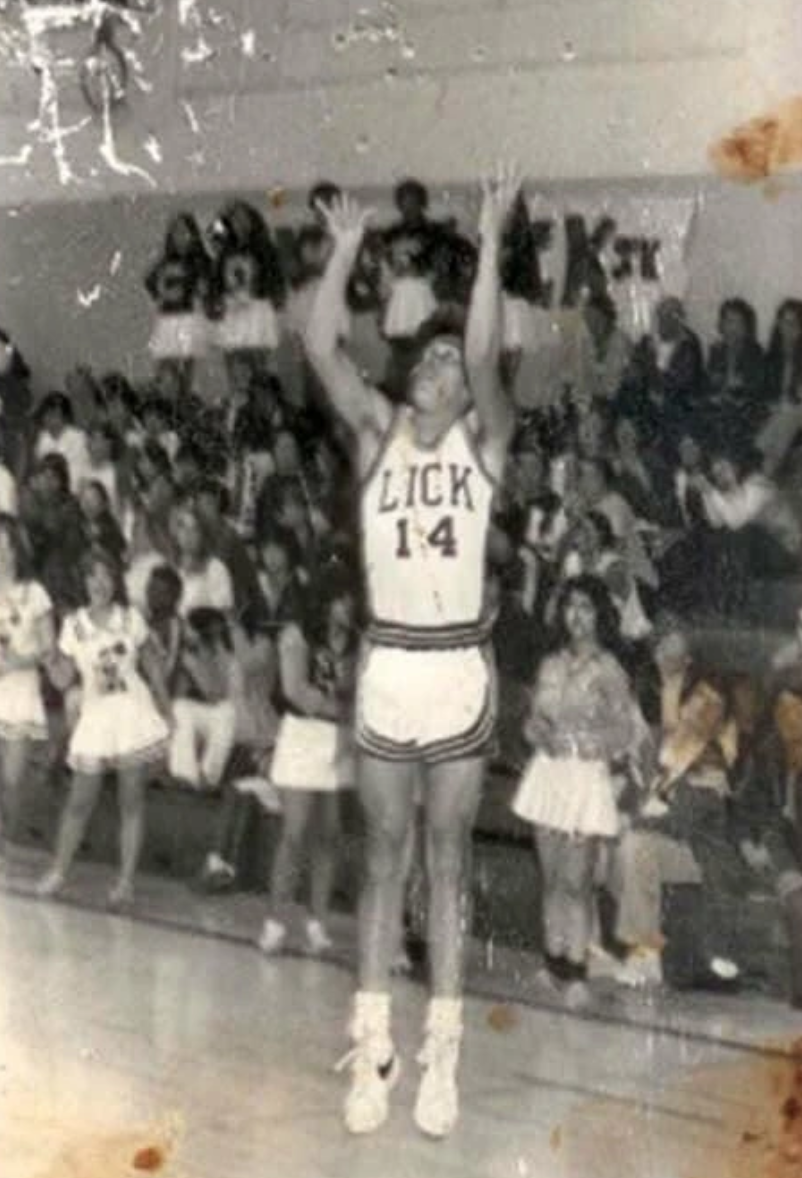
Six years later, I had my chance. As a senior at James Lick High School, I was co-captain and starting shooting guard for the varsity basketball team. We won our first game on opening night. I had a good game and earned a top 10 spot on the all-tournament vote tally. So far so good. My stomach churned with excitement and anticipation.

After the game, a bunch of students celebrated the victory at the neighborhood Round Table Pizza. My teammates and I walked into the place like conquering heroes. On the way home, my friend lost control of his car and crashed it head-on into a telephone pole. A few hours later, I was sitting in the Kaiser emergency room as a doctor stitched the deep cut on my forehead. The doctor said no to basketball for a week. 

It felt like my dog had died. I suffered sitting on the bench wearing jeans and a letterman jacket watching my team lose the next two games. Something that I had wanted since the 6th grade went up in smoke right before my eyes. There would be no nets to cut down, no all-tourney trophy to hold at mid-court, no cheering crowd. I replayed the car hitting that pole over and over in my mind. Little did I know that those two nights helplessly sitting on the bench wouldn’t be the last time my heart would ache.

Suffering is part of life. The central story of Christianity is the suffering Jesus endured at the hands of his enemies. Buddhists believe that suffering is a natural state of living. Nineteenth century German philosopher Friedrich Nietzsche once said that “to live is to suffer.” Ancient philosophers don’t have the last word on suffering. A couple of 20th-century lyricists come to mind. They put into simple words what highbrow intellectuals have been telling each other for thousands of years.

Jose Alfredo Jiménez, arguably Mexico’s greatest composer, wrote in the mid-20th century about emotional pain and suffering.

La vida no vale nada. Comienza siempre llorando. Y así llorando se acaba. (Life is worthless. It always starts out crying and, like that, it ends crying.) 

His massive body of work contains beautiful and elegant lyrics on life’s struggles. The concept of suffering consumed him so much that he ultimately drank himself to death. Cirrhosis of the liver took his life at 47 years old.

American country music icon Hank Williams also wrote haunting lyrics about pain and anguish. His music brings life to the agony of everyday living, loving and loss.

The silence of a falling star. Lights up a purple sky. And as I wonder where you are, I’m so lonesome, I could cry.

The official cause of the 29 year-old singer’s death was heart failure caused by the combination of alcohol and morphine, no doubt to soothe his pain.

Suffering is loosely defined as experiencing pain, sorrow, or hardship. It comes in all forms. According to Buddhists, there are generally three kinds of suffering: mental and emotional torment, physical pain, and death. Catholic tradition adds two more: humiliation and physical exhaustion. More than 4,000 years of philosophy, spirituality, and scholarship tell us that there’s no way to avoid one or more of these types of suffering on a daily basis.

When we think of suffering, big things come to mind: a fatal illness, death, a break-up, physical pain caused by a car accident, broken limbs, or migraine headaches. Suffering also comes in small packages. A flat tire, getting to work late, a gossipy co-worker, and an ankle sprain can all cause some level of mental torment, physical pain, and humiliation. 

Like most people, I always believed that life was all about having fun interrupted by a few hard times here and there. As a kid, I lived with both parents and five brothers and sisters in a safe environment, played baseball with neighborhood kids at the school down the street, and basketball on my driveway. We always had food to eat and had the same roof over our heads until we left the nest. It never dawned at me that life could be anything but wonderful with minor exceptions.

In high school, things got more complicated as the pendulum started to swing. It hurt when Dad furrowed his brow and shook his head in disappointment or Mom was upset at me for one thing or another. Focusing on academic performance, pursuing athletic accomplishments, and managing relationships began to eat up more of my time. Mental, emotional, and physical suffering followed. Nevertheless, suffering was still the exception, not the rule.

Life after high school was hard. I flunked out of San Jose State University after three semesters. Despite a sharp intellect and a solid work ethic, I embarked on a string of dead end jobs. I agonized over my circumstances knowing that my natural talents were not visible to my work mates or future employers. Burying myself into books had no practical purpose for the arc my life was taking. I grew frustrated and my anguish accelerated.

Suffering was the order of the day everyday. Drinking and carousing provided brief relief from the pain that racked my mind, body, and soul. Once the music stopped, the anguish resumed with more intensity. The physical and emotional hangovers lasted just long enough to jump back on the merry-go-round of suffering, shameless partying, and feeling sorry for myself. I finally overcame academic failure and forged a new direction.

Although ambition and promise were the new orders of the day, sorrow and pain still paved life’s path. The passing of Mom and sister Patty, job losses, election defeats, political failures, a massive heart attack, a horrific summer on life support, and a decade living with heart failure kept heartache chugging along. Marriage to Sandra, the birth of our girls, professional and some political success, and a heart transplant only served to soothe the ache of sustained suffering.

Since my heart transplant, I’ve developed a fascination with suffering and where it fits in our lives. The emotional and physical pain suffering inflicts on all of us make us naturally want to avoid it at all costs. The Spanish word for fun is diversión. While not a literal translation, the word has the same root as the English diversion. What are we  trying to divert ourselves from? Suffering, of course.

My heart failure and transplant journey have given me a new perspective on suffering and its assortment of so-called remedies. A brief scrolling through social media shows people “living their best lives” on vacation, at parties, and doing all kinds of fun stuff. The question is, Are those activities what life is all about or are they merely short-lived diversions from the daily drudgery of going to work, paying bills, fighting with family, raising kids, doing chores, and on and on?

That question has real life and death meaning for me. Living my best life was working long hours, drinking gallons of beer with a few shots of tequila here and there, and eating gobs  of fatty and unhealthy food. After a decade of heart failure and transplant, those diversions from suffering are no longer available to me if I want to continue living. I had to flip the script. I needed to find a way to live my best life without work, alcohol, food, or elaborate vacations every year, among a host of other temporary feel-good distractions.

I went back to the highbrow intellectual guys to find answers. Taking another page from the Nietzsche playbook, “out of life’s school of war—what doesn’t kill me, makes me stronger.” I’ve endured so much, especially during the past 14 years. Nevertheless, I’m still here. I’m mentally stronger with the character needed to face challenges head on. I have a better outlook on life and look forward to whatever each new day brings.

Nietzsche also told us that “to survive is to find some meaning in the suffering.” St. Paul the Apostle gave me a starting point. In his Letter to the Romans, he was trying to unify warring factions of the nascent church in Rome. As in any conflict, the differences in opinion among the groups caused much pain and suffering. St. Paul provided a recommendation to the Romans that has formed the foundation of my hope to flip the script on the never ending cycle of trying to avoid suffering through the pursuit of pleasure.

“Rejoice in your suffering,” St. Paul wrote in Roman 5:3-4, because it ultimately leads to hope. My heart failure journey came to an abrupt and blessed end on April 16, 2020. That’s when a new journey began. Suffering, real and imagined, old and new, continues to endure just as Nietzsche told us. “To live is to suffer.” My post-transplant story is all about rejoicing in my suffering “to find some meaning in it.”

***

Note: The story continues next Wednesday.

At a Crossroads

Eddie García graciously shared his inspirational journey with our leaders. His relatable stories, wisdom, and experiences resonated with our leadership team and inspired us to continue performing at a high level. ~Rigo Topete, Regional Vice President Sales & Marketing, Comcast Pacific Northwest Region

* * *

I nervously walked into a hotel banquet room full of sales executives and managers in Olympia, Washington. The group was named the top performing sales team in the Pacific Northwest the year before. Company executives expected the team to repeat as the region’s most prolific sales team by exceeding its record-breaking performance from the previous year. The stakes were high. The company invited me to share my story and help inspire sales leaders to meet the moment.

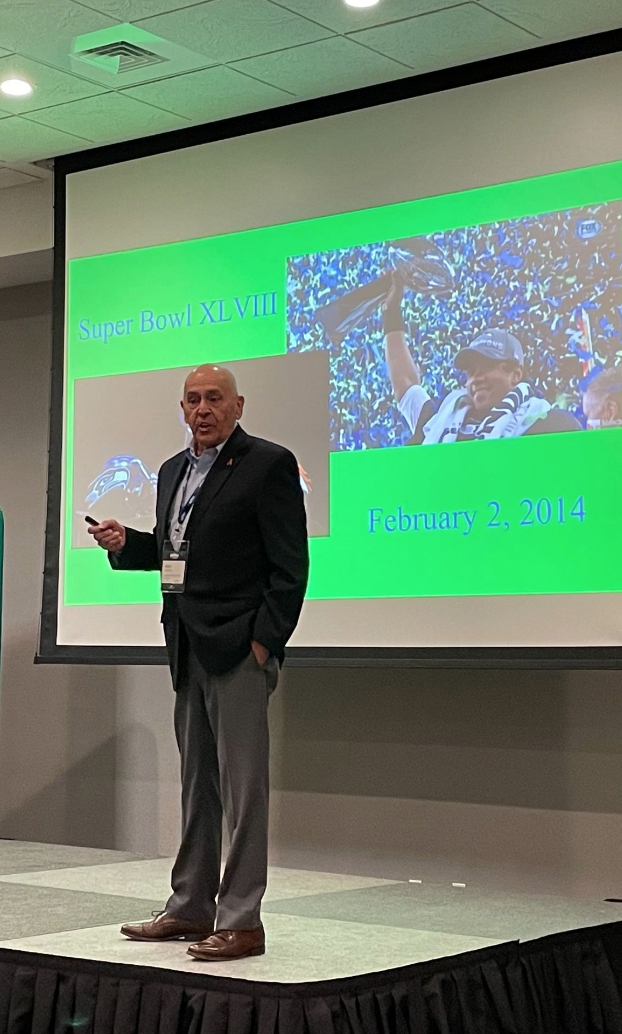
My pregame jitters came from the fact that there were 100 or so seasoned professionals in the room who had “been there and done that.” What could I say that they probably hadn’t already heard? I prepped tirelessly for weeks to make sure I would deliver a unique and meaningful speech. I decided to start my remarks by developing a relationship with those in attendance by telling a story about how their beloved Seattle Seahawks faced similar expectations and challenges the season after winning Super Bowl XLVIII in 2014.

Many in the audience shook their heads at that memory, smiled, and acknowledged my presence on stage. It was calming and gave me the confidence to share my story. I moved along and talked about the challenges of suffering a massive heart attack, living a decade with heart failure, and managing a heart transplant. 

I described how accepting God’s will is the foundation of faith and how rejoicing in my suffering led to hope by giving me the endurance and character needed to survive. Ultimately, it was unselfish love for Sandra and the girls that gave me the courage to fight day in and day out. The moral to my health crisis story, I emphasized, was how the power of faith, hope, and love carried me through that difficult time.

I urged the group to consider using that formula to lead their teams to another award winning year. They should have faith by accepting the fact that expectations were high and other teams were gunning for them. Rejoicing in that challenge would help them persevere through ups and downs, strengthen the team’s character, and turn hope into an action word, instead of an empty desire. I expressed how giving oneself for the sake of others is the very definition of love. By having each other’s backs, rather than infighting, unselfish teamwork would carry them across the finish line. 

When I concluded my remarks about 20 minutes later, the executives and managers rose to their feet in a rousing standing ovation. I was overwhelmed by the reaction and relieved that the mission was accomplished. After 30 minutes or so of taking questions, I headed to a table at the back of the room to sign books. I took time to talk with each and every person who wanted to share a story about family members with heart disease, cancer, and other chronic illnesses. With a story about conquering her own battle with cancer, one woman and I rejoiced together in our blessings.

On the flight back to San Jose, I reflected on the day and the meaningful conversations with amazing leaders. First and foremost, I felt gratitude for being able to touch the lives of others. I love being on stage and sharing my story to inspire people to persevere through life’s challenges. Another thought running through my mind was singularly selfish. Professional speakers make anywhere from $5,000 to $25,000 for doing exactly what I did in Olympia. My compensation for that appearance was nominal by comparison. 

Those thoughts and calculations came and went before landing at San Jose Mineta International Airport. Since that time, ideas about becoming a professional speaker have crossed my mind many times. My reasoning always begins with the opportunity to share my inspirational story with a wide audience and delves into potential financial gain. That’s where any further consideration of the idea slowly slips away.

I know what it takes to be a professional at anything, especially if the goal is to be the best I can be. It involves taking risks, hard work, and full commitment. At my age (60 years old) and because of the harrowing health journey I’ve endured, I’m just not sure I’m prepared to do what it takes to start a successful inspirational speaker business. I go back and forth in my mind analyzing the pros and cons of such an endeavor. So far, the cons are winning the day.

Recently, I became aware of a local organization in the market for an inspirational speaker. The proposed budget was around $7,500. The wheels in my head started turning and my stomach churned with excitement. I could do it, and for much less! I thought a second about offering my services before ultimately deciding not to speak up. I’m not sure why.

After thinking about why I didn’t make the offer, two things came to mind. First, the old imposter syndrome demons began to creep in because I wasn’t even considered. Maybe I’m not worth that amount of money and I’m just a legend in my own mind, the demons whispered into my ear. My previous speaking engagements told a different story. All audiences I’ve addressed react in the same enthusiastic way as the leadership team in Olympia. So maybe it wasn’t those old negative thoughts in action that kept me silent.

The second reason is that perhaps subconsciously I didn’t want to open a can or worms that couldn’t be closed. Could securing that speaking opportunity have been a slippery slope toward risk taking, working hard, and being completely dedicated to the work again? I’ve been down that path and it didn’t go so well for me or for my family. Nevertheless, the conversation put me in a self-imposed crossroads for a few days. 

I spent those days praying and reflecting on what really mattered. Was my ego tugging at my better senses? Yeah it was a little of that. Was it the potential financial gain? Yeah, of course. Who can’t use more money? Was it the fear that my inspirational story will never reach the masses? Yeah, that’s a biggie for sure. In the end, as always, it was faith, hope, and love that carried the day. 

If God wants me to be a professional speaker, He’ll let me know and I’ll do my part. In the meantime, I’ll rejoice in my suffering, fully accepting that I’m a great storyteller who isn’t on a big stage. I’ll persevere by seeking opportunities to speak at small gatherings and local events. Character, confidence, and commitment to the cause of inspiring others will strengthen my resolve and give me hope to keep sharing my story.

Between speaking opportunities, I’ll be home spending time with my family, washing dishes, folding clothes, and making dinner from time to time. I’ll also keep working on community passion projects by coaching emerging Latino and Latina civc leaders, teaching high schoolers about leadership, and advocating for my fellow transplant recipients. I’ll get in some reading and writing too. At the moment, this seems like God’s plan for me. I’m happy to do my part to fulfill His plan as best as I can, and I’m grateful that He guided me through the crossroads.

Roots at Harmon Park

My parents (Lico and Marie) met on a late summer day in 1949 when Mom went out to the neighborhood park with a cousin to watch some boys play baseball. Mom caught the eye of Dad as he strutted around the diamond with a smile that could be seen across the field. He was calling at my grandmother’s front door the next morning, respectfully asking permission to talk to my mom.

~ Summer in the Waiting Room: Faith • Hope • Love, page 11

* * *

I remember being a  little boy playing by myself with toy cars on the sandy dirt in the hot desert sun. Every few minutes or so, I stopped to marvel at the jumbo jets that roared just above my head and the roof of the small house on the south side of Phoenix, Arizona. After dark, I would go inside and endure the humidity caused by the old swamp cooler that was supposed to refresh those inside from the suffocating heat. Like clockwork, every few minutes or so, an airliner departing Phoenix Sky Harbor Airport shook the little home as its jet engines boomed above.

Those are the most vivid memories I have of visiting Grandma and Tía Lipa in the early 1970s. My parents grew up in South Phoenix and met there in 1949. I have many first and second cousins in Phoenix. Dad was the youngest in his family and I’m the fifth of six siblings. Due to distance and a huge age gap, I never developed relationships with my Phoenix kin, especially after my parents passed away. More recently, we have been connecting via social media. I hadn’t been there since the late 1970s, until two weeks ago. 

The occasion was my cousin Rojelia’s 80th birthday. The birthday girl’s mom was Dad’s older sister. It was an event many months in the planning. My big sister Barbara organized the Lico and Marie García delegation. As I’ve chronicled on this blog and in my book, the past 14 years have been a roller coaster of emotions for me. Faith, hope, love, and mindfulness have been the bedrocks on my post-transplant journey. Making a pilgrimage to Phoenix, Arizona wasn’t on my radar. Barbara persisted and Sandra insisted. How could I say no?
Sandra and I took an early morning flight out of Mineta San Jose International Airport for the three-day event. Landing at the Phoenix Sky Harbor Airport had no special significance. We arrived in time for a big party (Dad’s parents had 42 grandchildren!) at the Veterans of Foreign Wars, Post 41 in South Phoenix on Saturday. Relatives from all over the United States danced the night away to a DJ and a live band after dinner. 

I had a blast catching up with California cousins I hadn’t seen in more than a decade. We were sharing and laughing at the same old stories that made us laugh every time we got together. Seeing others with whom I’ve been connecting with on Facebook was nice. It was the first time I’d seen many of them since the last García family reunion in San Jose 42 years ago. The 1982 reunion weekend gave me a sense of grounding to something bigger than my immediate García family. That had slowly dissipated during the past four decades, until two weeks ago.

On Sunday morning, after breakfast at VFW, Post 41, Barbara and Rojelia led a tour of my parents’ South Phoenix neighborhood. As we slowly drove by the house Mom grew up in on West Pima Street, the first thing I noticed was a jet leaving the airport. Suddenly, the tour stirred something in my soul I couldn’t recognize. Two blocks away, kitty corner to Mom’s house, stood the projects Dad called home throughout his youth. We got off the car and entered the complex as another jumbo jet climbed into the sky.

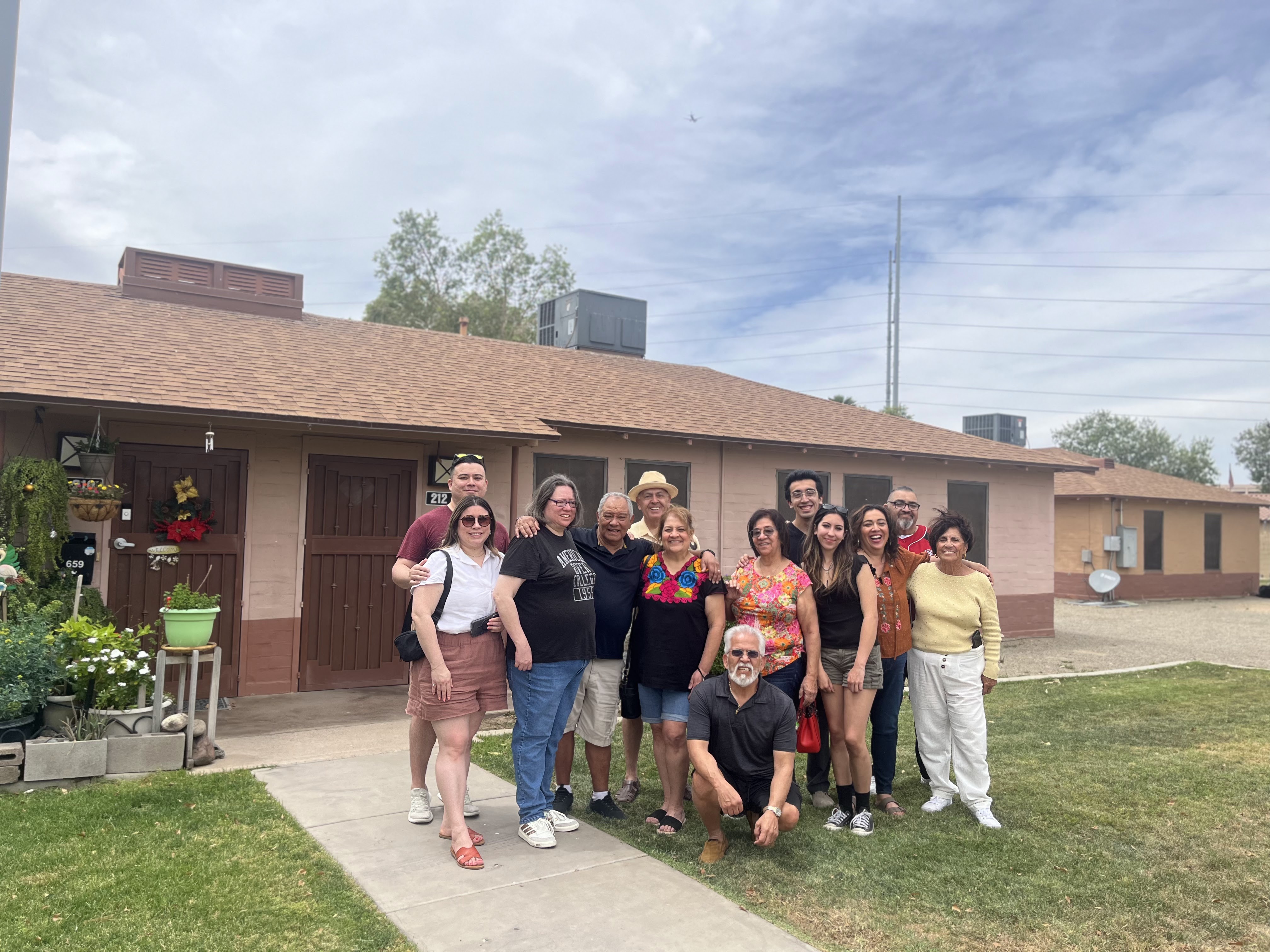
The pre-WWII buildings looked like army barracks facing an inner courtyard. After some debate about which apartment belonged to our grandmother, we settled on apartment #212. Rojelia recounted how she was born in the one-room living quarters in 1944. She remembers being a mocosa (snot nosed kid) watching Mom and Dad taking wedding photos in the courtyard. “It was all so elegant,” Rojelia reminisced. 

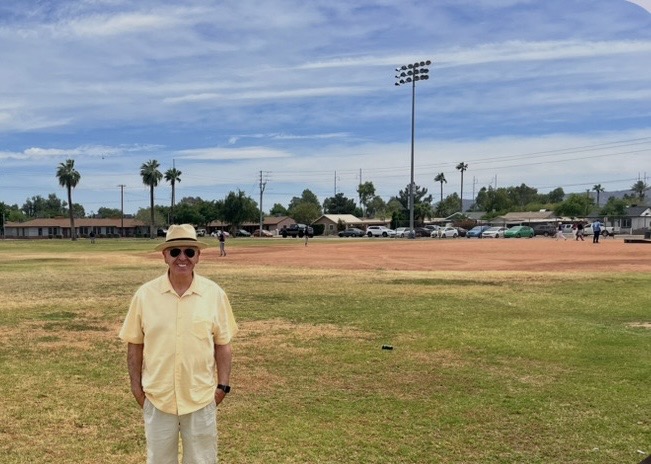
Mom had a collage of that day hanging in our small living room when I was a kid. We were standing and taking pictures of our own on the very spot where Mom and Dad celebrated their wedding day 74 years ago . . . I was transfixed! We whipped our cars around the corner and stopped at Harmon Park. My cousin told us that the baseball field at Harmon Park is where my parents met. 

I wrote the passage on page 11 of Summer in the Waiting Room about my parents meeting at a park from memories and family oral history. I may have been to Harmon Park as a young boy, as I vaguely remember walking to a baseball field during the trips we made to visit Grandma and Tía Lipa. But, two weeks ago was definitely the “first time” I’ve been there. There was a baseball game in progress. I could picture Dad “as he strutted around the diamond with a smile that could be seen across the field,” and I could see Mom demurely smiling from the bleachers. 

Barbara woke me up from my trance when she said, “I didn’t know you loved airplanes so much.” She mentioned that I looked up at every airliner that flew by. I mumbled something about how the sound reminded me of our visits from over 50 years ago. It was another way of saying, “I love those jets flying out of that airport. The boy playing with toy cars in the sandy dirt had come full circle to South Phoenix.

When mom passed away in 2003, eight years after Dad, I felt empty inside like a hot air balloon floating through life without an anchor. I focused on my home base in East San Jose and the home Sandra and I were building with our daughters. That foundation created a strong tree trunk of our little family tree. But there weren’t any Mom and Dad roots. Through the years, we visited California’s central valley where Sandra’s parents started their story. I have friends who have ventured back to their roots in Texas, Mexico, and a Native American reservation in Northern California.

I was quietly envious of the stories they brought back. As a man, I didn’t have the experience of “this is where it all started.” Until two weeks ago. Standing in the park where my parents met some 75 years ago was amazing. I looked to my left and saw Mom crossing West Pima Street on her way to a baseball game. I looked to the right and saw Dad running across 3rd Street to meet his teammates on the diamond. Between those glances, I watched each jetliner fly by above. I felt the roots of the Lico and Marie García family beneath my feet.

We finished the tour at St. Anthony’s Church, where my parents were married in 1950. It’s just two blocks north of Harmon Park. It was cool, but a little anticlimactic after the cathartic experience at the baseball field. The next afternoon, Sandra and I were securely buckled in our seats on American Airlines Flight 1667 when the jet engines roared as the plane screamed down the runway. Less than a minute after lift off, we soared above the little house on West Pima Street, the projects on 3rd Street, and Harmon Park, where my roots are firmly in place.

It was a three-day whirlwind of emotions for the ages. Connecting with family members I hadn’t met and reconnecting with others I hadn’t seen in decades was special, especially since we all descended from a matriarch who lived in a public housing one-room unit. I don’t know if or when I’ll return to South Phoenix, Arizona, but I’ll always cherish this trip. Thank you, Barbara for persisting and thank you, Sandra for insisting. I love you both. And, yes. I love those jets flying out of that airport.

Get Away From It All

I lived alone, in the woods, a mile from any neighbor . . .

~ David Henry Thoreau, Walden, 1854

* * *

I’m fascinated with the concept of mindfulness. According to mindfulness guru Jon Kabat-Zinn, mindfulness is “paying attention, on purpose, in the present moment, non-judgmentally.” It first came to my attention about 20 years ago as a fellow with the American Leadership Forum, a national leadership organization with a chapter in Silicon Valley. At the time, I was an ambitious corporate climber and aspiring civic leader. I had places to go, people to see, and things to do. My mind swirled with ideas about the future. I didn’t have time to live in the “present moment.”

Too bad for me. According to the National Institute of Health, the benefits of the practice include reducing anxiety, improving sleep, lowering blood pressure, clearing the mind for better decision-making . . . the list goes on and on. Six years after becoming a Senior Fellow with the American Leadership Forum, my mind was cluttered, I was anxious, I didn’t sleep well, and my blood pressure was soaring.

Since a massive heart attack, living a decade with heart failure, and a heart transplant rocked my world, I’ve been fascinated with the concept of mindfulness. An amazing therapist with the Kaiser Santa Clara advanced heart failure team reintroduced the idea of mindfulness to me. Good for me. I no longer had places to go, people to see, and things to do. I read a bunch of books, had great conversations with my therapist, and subscribed to the Calm App to learn more. The more I learn, the more fascinated I’ve become. 

One of the books I read is an American classic, Walden by David Henry Thoreau. It’s a beautiful book about the author’s experience getting away from it all by living in the woods for 2 ½ years by himself. He describes in graceful detail the wonders of the natural world. His observations of a blue jay or sycamore tree take paragraphs to describe. The book is really hard to read unless you’re mindful of every word. Thoreau’s point is clear. There’s more to life than hustle and bustle.

The first sentence captured my attention. He writes, “I lived alone, in the woods, a mile from any neighbor.” What he describes is in the middle of nowhere. His only connection to civilization was the “sound of a locomotive” far off in the distance arriving in the nearby town of Concord, Massachusetts. Otherwise, the surrounding woods were so quiet he could hear every faint sound nature makes. 

As I was reading the book, I had a hard time believing that he was that secluded. The center of town was 1.6 miles from Walden Pond. That’s not very far. I couldn’t imagine being in the boondocks a mile and a half from my house. While Thoreau’s prose is elegant and vividly descriptive, I couldn’t help but call “bullshit” that he was that close to town, yet completely isolated. 

I know, I know. The stuff that runs through my mind seems silly and inconsequential. BUT . . . come on Mr. Thoreau!

As I pulled into the parking lot at the entrance of Alum Rock Park the other day, I decided to test the accuracy of Thoreau’s description. Alum Rock Park sits in a rugged canyon in the foothills east of San Jose. It has many trails that lead deeper into the canyon and into the hills that surround the canyon floor. I thought it a perfect place to experiment with the idea that one could be isolated less than two miles from “civilization.” 

From the parking lot, I started at the trailhead of the Penitencia Creek Trail that winds its way into the park. My goal for the hike was to pay attention to the nature around me on purpose, in the present moment, and without judgment. Once I was 1.6 miles away from the parking lot, I would survey my surroundings to determine if Thoreau’s representation of his surroundings was convincing.  

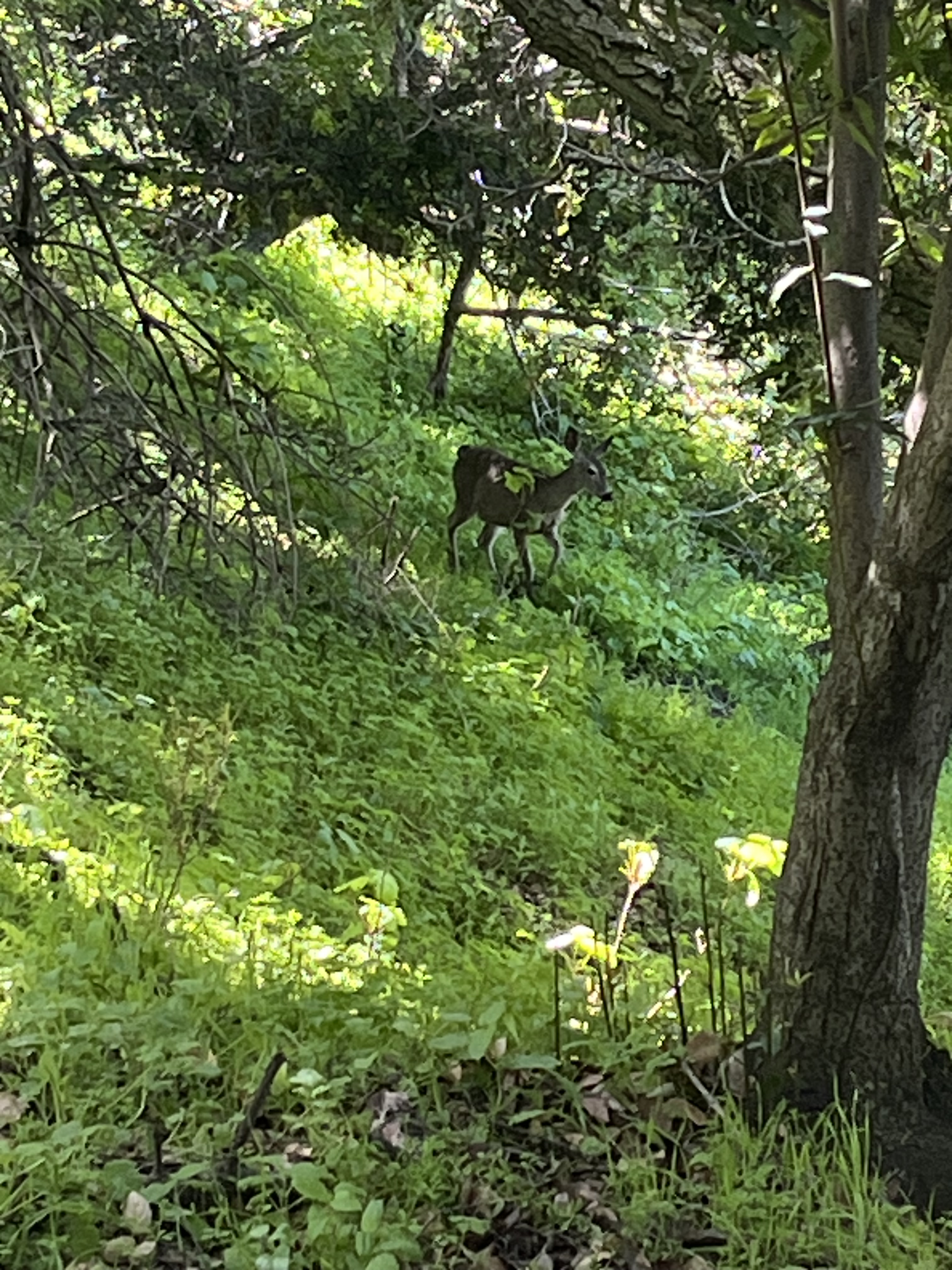
Walking along the creek, I immersed myself in the sights and sounds of the trail. The rainy season turned Alum Rock Park into a beautiful canvas of many shades of green. The hillside is cluttered with uprooted trees and stray branches thrown about most likely from storms. Carpet-like grasses and thin tree limbs swayed in the wind while a couple of deer nibbled on leaves in the distance.

I initially thought that nature sounds playing in my airpods would be a cool soundtrack. No music. No podcasts. After a few seconds, I realized that it was a dumb idea of a typical 21st century Silicon Valley man addicted to electronic devices. The more I thought about it, the sillier it sounded. I chuckled at my total disregard for mindfulness. Water running through the creek, small pebble gravel crunching under my hiking boots, and birds chirping were the only sounds I heard as I walked. 

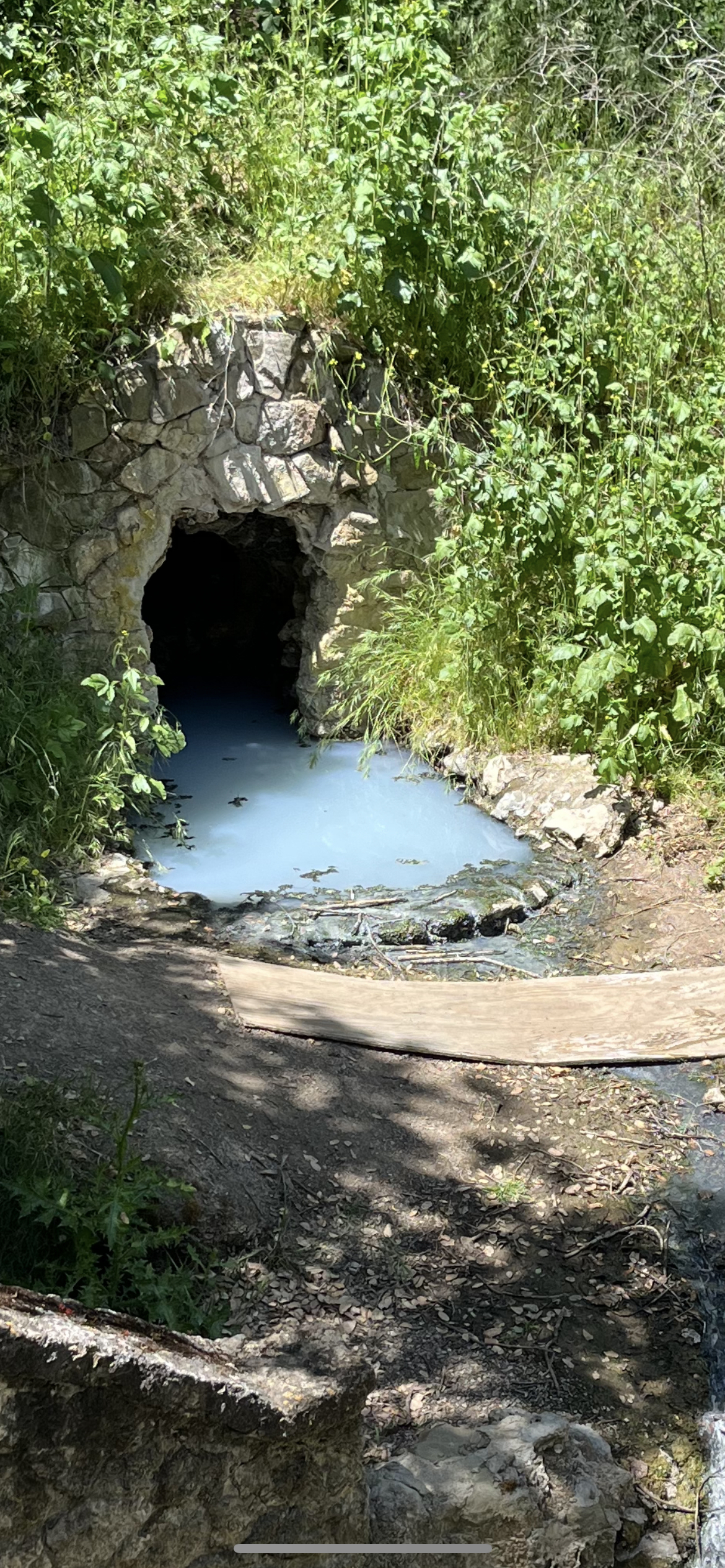
Finally, I stopped at the ruins of mineral springs from a bygone era of the park. From the late 1800s to the 1930s, people flocked to Alum Rock Park because they believed that the mineral water there had healing effects. I was standing 1.6 miles from the trailhead parking lot and the housing development nearby. Looking around, I saw squirrels scurrying about, a couple of quail trotting across the trail, and a vulture gracefully gliding high above the ridge line of the canyon looking for lunch.

I was in the middle of nowhere! 

Birds were singing and chirping, the creek was babbling, the sound of wind blowing through the trees brought an indescribable peace and calm to my being. Like Thoreau’s “sound of a locomotive” in the distance, the only sign of civilization as I stood 1.6 miles from a neighborhood was the faint roar of a jetliner departing San Jose Mineta International Airport flying high above to an unknown destination.

I hiked a little further into the canyon before turning around to head back to the parking lot. The return journey was also filled with wonder. The sounds of singing birds, animals scampering in the brush, and rushing creek water were louder and more distinctive. I was admiring a family of ducks paddling in the creek when I noticed a vulture flying right at me. I smelled myself and checked the heartbeat on my Apple Watch just in case the vulture knew something I didn’t know. To my relief, the large bird landed on a tree branch with a dead bird in its beak. 

What did my little experiment teach me? Thoreau was telling the truth. You could be less than two miles from civilization, yet be totally alive, clear-minded, and isolated from the noise of the world. Maybe, just maybe, the real truth coming from my experiment is that “paying attention, on purpose, in the present moment, nonjudgmentally” can put you in the same place even amid the chaos of life.

Hmm . . . I have some more work to do on this mindfulness stuff.